

The Yanni Integration Approach (YIA) at Psychological Services of New York
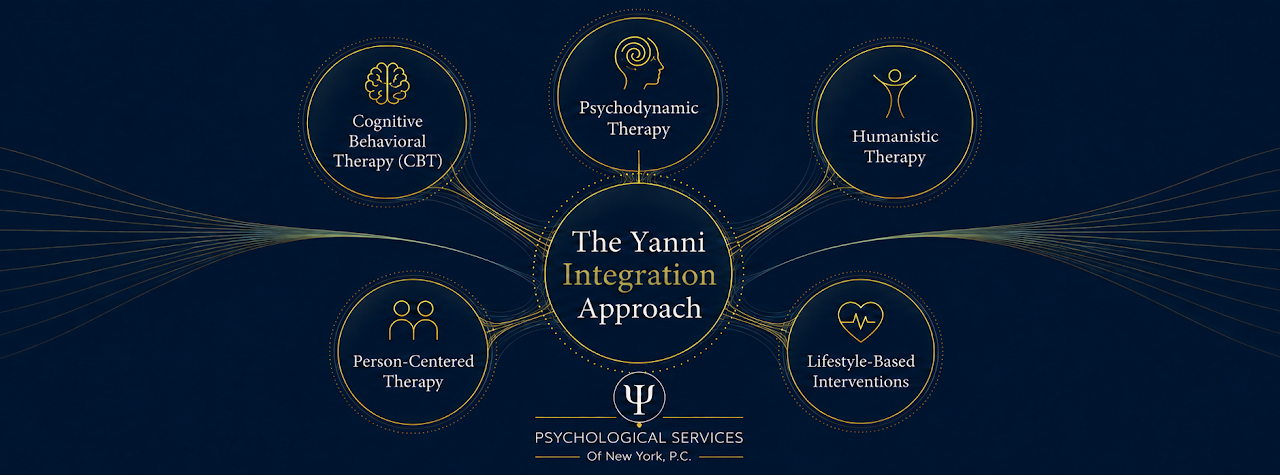
The Yanni Integration Approach (YIA) is a practical framework for integrative therapy developed by Dr. Joseph R. Yanni, licensed psychologist and founder of Psychological Services of New York, P.C. The model helps clinicians organize case conceptualization, clinical decision-making, therapeutic relationships, and real-world treatment planning by drawing from Cognitive Behavioral Therapy (CBT), psychodynamic therapy, humanistic therapy, person-centered therapy, and lifestyle-based interventions. Rather than applying one rigid method to every client, YIA emphasizes adapting treatment to each person’s needs, personality, developmental stage, goals, strengths, and circumstances while maintaining a clear and thoughtful clinical direction.
The Yanni Integration Approach
-
The Yanni Integration Approach is a practical framework for understanding and applying integrative therapy in real-world clinical practice. It was developed from years of clinical work with children, adolescents, adults, and families, as well as experience in school-based settings, private practice, and clinical supervision.
At its core, the Yanni Integration Approach recognizes that no single therapy model fits every client, every concern, or every moment in treatment. Clients often enter therapy with complex and layered needs. They may need practical coping skills, emotional validation, deeper self-understanding, relational support, lifestyle changes, or help making sense of repeated emotional and behavioral patterns.
The Yanni Integration Approach helps organize these needs into a flexible clinical framework. Rather than replacing established therapy models, it offers a way to thoughtfully bring them together through integrative psychotherapy, clinical judgment, and attention to the therapeutic relationship.
-
The Yanni Integration Approach is grounded in the belief that therapy should be individualized, collaborative, and responsive. Some clients need structure and practical tools. Others need time to feel understood and emotionally safe. Many need both.
This approach draws from several major therapeutic perspectives, including Cognitive Behavioral Therapy, psychodynamic therapy, humanistic therapy, person-centered therapy, and lifestyle-based interventions. Each model offers something important, but the value of integration comes from knowing when and how to use each clinical lens.
For clients, this means treatment is not limited to one rigid method. Therapy can focus on immediate concerns while also exploring deeper emotional patterns, relationships, personal history, daily routines, and the client’s larger life context.
For individuals seeking therapy in Scarsdale, therapy in Pleasantville, or psychotherapy in New York, an integrative approach allows treatment to be adapted to the person rather than forcing every client into the same model.
-
The Yanni Integration Approach is designed to help clients feel understood while also helping them move toward meaningful change. Therapy may involve learning coping strategies, identifying emotional triggers, building insight, improving communication, strengthening relationships, or making practical adjustments in daily life.
For a child or adolescent, this may involve emotional regulation, parent collaboration, school-related support, social difficulties, anxiety, behavior concerns, or life transitions.
For adults, this may involve stress, relationships, parenting, work pressure, anxiety, depression, grief, identity, trauma, or recurring emotional patterns.
For families, this may involve communication, expectations, emotional understanding, behavioral patterns, and practical strategies for improving daily functioning.
The goal is not simply to reduce symptoms. The goal is to help clients better understand themselves, develop healthier coping patterns, and create change that can be carried into real life.
-
A central part of the Yanni Integration Approach is balancing insight and action. In therapy, insight helps clients understand emotional patterns, relationship dynamics, and repeated struggles. Action helps clients apply coping strategies, make practical changes, and respond differently in daily life.
Some therapy becomes too focused on insight without enough practical direction. Other therapy becomes too focused on skills without enough attention to the emotional meaning behind the problem. The Yanni Integration Approach attempts to bridge these areas.
This means therapy can include both reflection and structure. A client may learn to challenge anxious thoughts while also exploring why certain situations feel so threatening. A client may practice communication skills while also understanding the emotional patterns that make communication difficult. A client may improve daily routines while also exploring the stress, avoidance, or self-doubt that interferes with follow-through.
This balance of insight and action is one reason integrative therapy can be useful for clients dealing with anxiety, depression, stress, emotional dysregulation, relationship concerns, family conflict, school challenges, and life transitions.
-
The therapeutic relationship is central to the Yanni Integration Approach. Before clients can meaningfully explore difficult emotions or make lasting changes, they often need to feel safe, respected, and understood.
Therapy is not simply a set of techniques. The timing, tone, relationship, and emotional context matter. A strategy that is helpful at one point in treatment may feel premature or ineffective at another point. For this reason, the therapist must remain attentive to the client’s readiness, emotional state, and level of trust.
The Yanni Integration Approach places strong emphasis on rapport, validation, collaboration, and clinical timing. The therapist’s role is to support, guide, reflect, challenge when appropriate, and help the client move forward without forcing treatment into a rigid formula.
-
The Yanni Integration Approach can be applied across different ages and clinical concerns because it is organized around the needs of the person, the problem, the relationship, and the timing of treatment.
With children, integrative therapy may involve emotional expression, behavioral support, parent guidance, anxiety management, school collaboration, and practical strategies for daily functioning.
With adolescents, therapy may focus on identity, anxiety, peer relationships, school stress, family conflict, emotional regulation, independence, and self-esteem.
With adults, integrative psychotherapy may involve stress, relationships, parenting, work challenges, depression, anxiety, grief, trauma, self-understanding, and life transitions.
With families, integrative work may include communication patterns, emotional understanding, parent support, behavioral strategies, and relational repair.
Because each person and family system is different, the Yanni Integration Approach allows therapy to remain flexible while still maintaining a clear clinical direction.
-
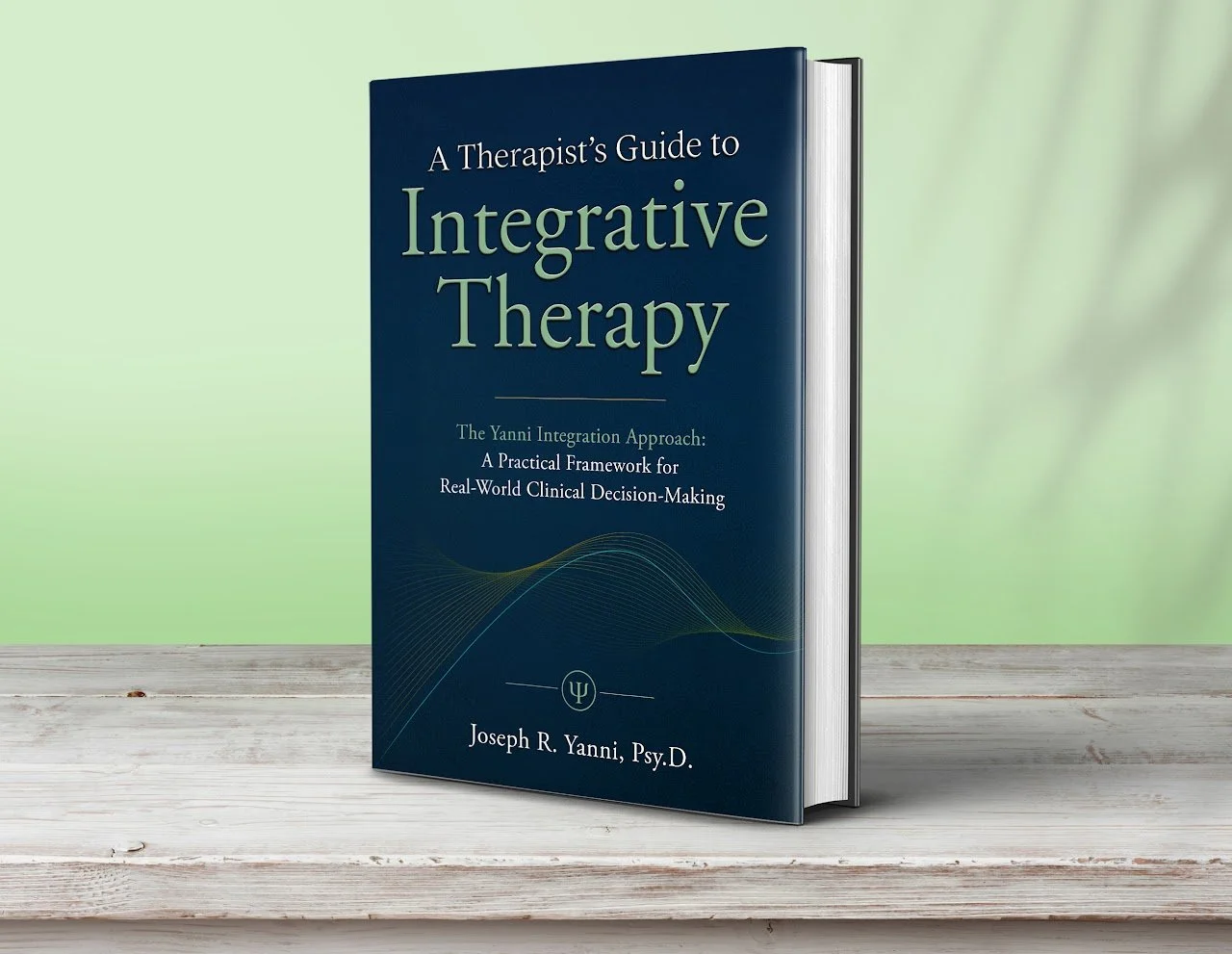
The Yanni Integration Approach is also the foundation of Dr. Joseph R. Yanni’s book, A Therapist’s Guide to Integrative Therapy, The Yanni Integration Approach: A Practical Framework for Real-World Clinical Decision-Making.
The book was written for therapists, counselors, supervisors, interns, and graduate students who want a practical way to think about integrative clinical work. Many clinicians are trained in specific therapy models, but real sessions often require flexibility. A client may shift from anxiety symptoms to family conflict, from avoidance to grief, from practical stress to deeper emotional pain.
Therapists must constantly decide what to focus on, how to respond, when to use structure, when to validate, when to explore, and when to help the client take action. These decisions require clinical judgment, case conceptualization, emotional awareness, and an understanding of the therapeutic relationship.
The book offers a framework for these real clinical decisions. It is not intended to replace established models. Instead, it helps clinicians organize their thinking and apply different therapeutic perspectives with greater clarity and intention.
-
The Yanni Integration Approach also recognizes that therapists are not separate from the work they do. Effective therapy requires clinical knowledge, emotional presence, self-awareness, and the ability to remain grounded through complex and demanding sessions.
For therapists, counselors, interns, supervisors, and developing clinicians, therapist self-care is not simply a personal wellness issue. It is part of sustainable clinical practice. The book addresses therapist reflection, preparation, emotional awareness, boundaries, self-care, and burnout prevention as important parts of ethical, responsive, and effective therapy.
This focus on the therapist matters because the therapist’s ability to stay present, thoughtful, and regulated affects the quality of clinical work. A strong integrative approach considers not only what the client needs, but also how the therapist prepares for, responds to, and reflects on the work.
-
A Therapist’s Guide to Integrative Therapy, The Yanni Integration Approach: A Practical Framework for Real-World Clinical Decision-Making explores the clinical decisions therapists make before, during, and after sessions.
Topics include therapist preparation, rapport building, case conceptualization, emotional validation, resistance, transference, therapy impasses, lifestyle considerations, therapist self-awareness, therapist self-care, and burnout prevention.
The book also examines how different therapeutic models can work together, including Cognitive Behavioral Therapy, psychodynamic therapy, humanistic therapy, person-centered therapy, and lifestyle-based interventions.
For early career clinicians, interns, and graduate students, the book can serve as a guide for developing clinical judgment and learning how to think more flexibly in sessions. For experienced therapists, it offers a structured way to reflect on integrative practice and refine clinical decision-making.
-
The Yanni Integration Approach is built around a simple clinical reality: therapy is complex because people are complex. Clients bring symptoms, relationships, histories, strengths, defenses, environments, habits, and hopes into the room.
A thoughtful integrative approach helps therapists respond to that complexity without becoming scattered or overly rigid. It allows therapy to remain grounded, flexible, relational, and practical.
Whether applied in clinical practice, supervision, training, or professional reflection, the Yanni Integration Approach is intended to support therapy that is responsive to the person, the problem, the relationship, and the moment.
At Psychological Services of New York, P.C., this approach reflects a commitment to individualized care, thoughtful clinical decision-making, and therapy that considers the whole person. For clients seeking integrative therapy in Scarsdale, integrative therapy in Pleasantville, or psychotherapy in New York, the Yanni Integration Approach offers a flexible way to understand emotional concerns, strengthen coping, build insight, and support meaningful change.
Learn More
Dr. Joseph R. Yanni further explains the Yanni Integration Approach in his book, A Therapist’s Guide to Integrative Therapy, The Yanni Integration Approach: A Practical Framework for Real-World Clinical Decision-Making.
The book is designed for therapists, counselors, supervisors, interns, and graduate students seeking a practical, grounded, and integrated way to approach real-world clinical work. It explores integrative therapy, clinical decision-making, case conceptualization, rapport building, emotional validation, lifestyle-based interventions, therapist self-awareness, and the role of the therapeutic relationship in effective treatment.
For clinicians interested in integrative psychotherapy, the book offers a flexible framework for understanding how different therapy models can work together while remaining thoughtful, ethical, relational, and responsive to the client’s needs.
Available Now on Amazon
In Kindle, paperback and hardcover editions.
A Therapist’s Guide to Integrative Therapy, The Yanni Integration Approach: A Practical Framework for Real-World Clinical Decision-Making is now available on Amazon.The book introduces the Yanni Integration Approach, a practical framework for therapists, counselors, supervisors, interns, and graduate students seeking a more flexible, intentional, and grounded way to approach real-world clinical work.Focused on integrative therapy, clinical decision-making, case conceptualization, rapport building, emotional validation, therapist self-awareness, and the therapeutic relationship, the book helps clinicians think more clearly about how to apply different therapy models in a thoughtful and responsive way.